
luxury property management
Luxury Property Management: A Fit-and-Proposal Guide for Rental Property Owners

Start with the fit decision, not the luxury label
The fit decision should begin with the work your rental property requires, not with the word “luxury.” A property-management label can sound precise while leaving the actual responsibilities undefined. Your decision becomes clearer when you compare the property’s operating demands with the scope, records, communication, and authority a manager is prepared to provide.
Luxury property management is described as emphasizing personalization, precision, and stewardship of complex, high-value properties rather than only efficiency and occupancy. Treat the label as a prompt for questions.
A strong management brief should do more than request a price. It should clarify the asset, operating priorities, service boundaries, reporting expectations, transition needs, and the method you will use to evaluate proposals. Those categories turn a broad search into a property-specific comparison.
Use this decision path:
- Define what makes your property demanding to operate.
- Convert those demands into responsibilities a manager must accept or coordinate.
- Set the records and reporting you need to oversee the property.
- Read the agreement for authority, cost, spending, and termination boundaries.
- Prepare the same information for any provider you ask to respond.
For a Bay Area property in San Francisco or on the Peninsula, local details such as location, building type, occupancy, and the condition of distinctive features belong in that brief. The same approach applies whether you own a single rental property or a small multi-unit asset.
Aim to document the fit between your needs and the proposed work. If the fit remains unclear after you have asked for scope details, pause before treating a polished presentation or a premium label as a decision.
Define what luxury management may—and may not—mean
The meaning of luxury management depends on the property’s complexity and the level of attention you need, not on a universal list of amenities. A published description contrasts traditional management, which commonly handles rent collection, repairs, and tenant communication, with a more personalized approach for complex, high-value properties.
That distinction can help you frame your evaluation. Personalization may mean that the manager understands your operating preferences and the property’s particular condition. Precision may mean that responsibilities, approvals, records, and communication paths are stated clearly. Stewardship may mean that the manager treats the property’s long-term condition and daily operation as connected concerns. These are evaluation ideas, not promises that every provider performs every task.
The label does not, by itself, tell you:
- Which repairs the manager coordinates and which remain yours.
- Whether leasing and tenant placement are included.
- How rent collection and owner distributions are handled.
- What financial categories appear in owner records.
- How often you receive updates or who communicates with you.
- What spending authority applies before you approve work.
- Whether the manager has experience with your property’s location, layout, condition, or operating model.
A property with distinctive finishes, a complicated layout, high service expectations, or unusual maintenance coordination may need more deliberate oversight than a straightforward rental. That conclusion still has to be translated into specific work. Ask what the provider will do, what the provider will coordinate, what information you will receive, and what remains your responsibility.
The distinction also matters when you compare proposals. A firm may offer ordinary operating tasks under a broad category while leaving higher-touch decisions outside the scope. Another may describe the same category with different approval limits or reporting practices. Compare the responsibilities, not the adjectives.
Use the luxury label to start a conversation about fit. Do not use it as a substitute for a written scope.
Translate the property into service requirements
The property profile should become a service-requirements map before you compare providers. A service requirement connects a condition or priority at your rental property to a responsibility, record, approval, or communication standard that a manager would need to address.
Start with the asset itself. Record the property type, location, number of units if applicable, occupancy, lease status, distinctive features, known maintenance pressure, and any transition issue. You do not need to turn the brief into a technical report. You need enough detail for a provider to understand what would be managed and where the operating burden sits.
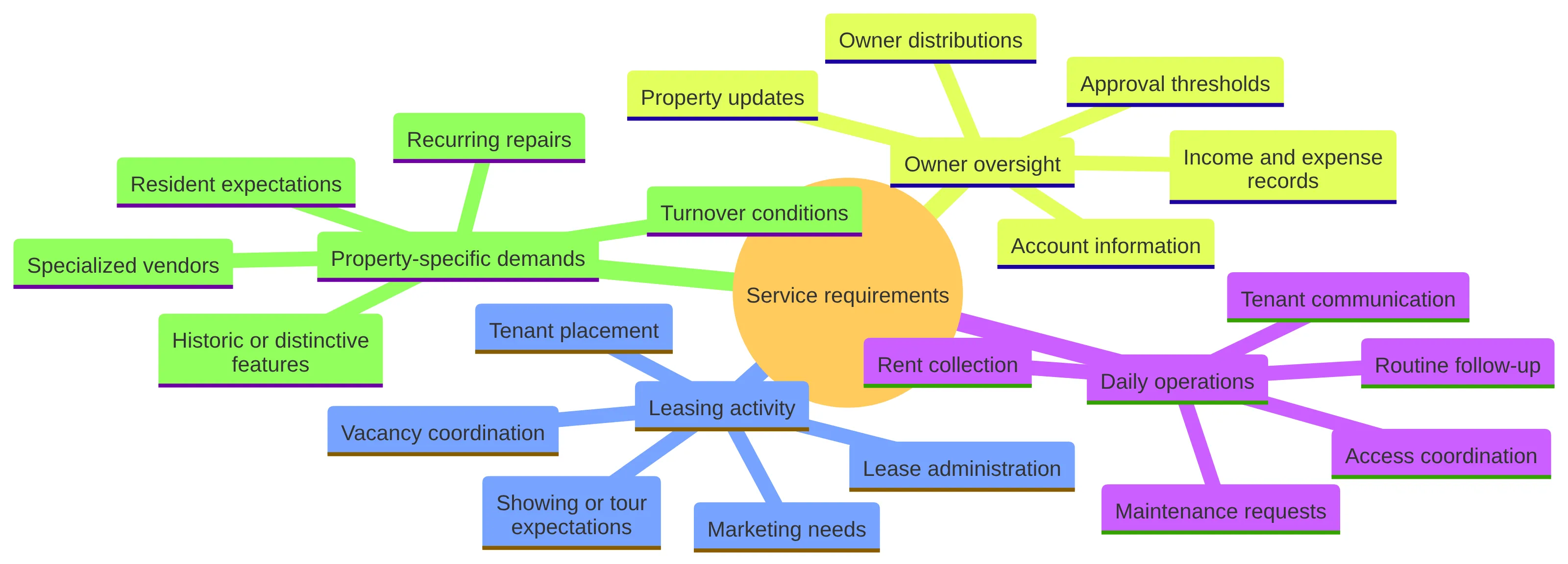
Then separate the requirements into four groups:
- Daily operations: rent collection, tenant communication, maintenance requests, access coordination, and routine follow-up.
- Leasing activity: marketing needs, showing or tour expectations, tenant placement, lease administration, and vacancy coordination.
- Owner oversight: income and expense records, approval thresholds, owner distributions, account information, property updates, and the way questions are escalated.
- Property-specific demands: historic or distinctive features, specialized vendors, recurring repairs, resident expectations, turnover conditions, and work that may require your direct decision.
For example, a vintage building in San Francisco may require you to identify character-defining features, recurring repair patterns, and any vendors who understand the property. A property in Atherton, Menlo Park, Redwood City, or Los Altos may have a different operating profile even when the same broad service categories apply. Treat location as an input to the scope, not as proof that a manager has addressed every local issue.
A complex property may need careful coordination even when its routine tasks look familiar. The point is not to assume that complexity requires a particular product. The point is to identify the work that must be covered and the evidence you will need to see afterward.
Write each requirement as a question that a proposal can answer: “Who handles this?” “What is included?” “What requires approval?” “What record will I receive?” and “What happens during a transition?” A provider that can respond specifically gives you a more usable basis for comparison than a provider that relies on a broad service label.
Test the operating scope across everyday responsibilities
The operating scope should connect everyday responsibilities to clear ownership, escalation, and records. Traditional property management commonly includes rent collection, repairs, and tenant communication, while The Housing Guild’s Bay Area management work includes leasing, compliance, maintenance, and accounting.
Use those categories to test the scope rather than assuming that “full service” answers every question. Ask for a direct description of the following:
- Leasing: Who prepares the listing, coordinates showings or tours, handles applicant communication, and manages tenant placement?
- Rent collection: Who receives payments, follows up on unpaid amounts, records receipts, and answers payment questions?
- Maintenance: Who receives requests, selects or coordinates vendors, obtains approval, tracks completion, and communicates status?
- Tenant communication: Which issues go to the manager, which go to you, and how are conversations documented?
- Compliance-related work: Which administrative tasks are included, and which require advice from a qualified specialist?
- Accounting: Which income, expenses, fees, distributions, and balances are recorded for your review?
Pay attention to boundaries. A manager may coordinate a task without taking responsibility for every decision connected to it. A manager may also require your approval before spending, changing a vendor, altering a lease term, or addressing a non-routine condition. Those distinctions matter more than a general promise of convenience.
Separate routine coordination from decisions that affect the property’s condition or your financial position. For instance, a proposal should make clear whether the manager merely receives a maintenance request, coordinates a repair, approves a vendor within a limit, or waits for your authorization. The same question applies to leasing, tenant placement, and rent-related follow-up.
Create a responsibility row for every recurring pressure you identified in the property brief. Give each row an owner, a trigger, an approval point, and an expected record. If a proposal leaves one of those fields blank, ask for clarification before you compare its price with another proposal.
The supported scope should be treated as a starting point for discussion, not as proof that every luxury-specific need is included. Match each requirement to an explicit answer.
Check whether financial records will support owner oversight
Financial records should let you trace rental income and expenses into a usable view of the property’s operation. Property-management accounting can itemize rental income and expenses such as maintenance, repairs, utilities, and management fees. It can also support cash-flow analysis by tracking rental income, vacancy rates, expenses, and the timing of cash inflows and outflows.
Your evaluation should therefore focus on the structure of the records, not only on whether a provider uses the word “accounting.” Ask what categories will appear, how payments and expenses are identified, how owner distributions are shown, and how you can connect a charge to the property activity that produced it.
Use this financial-record checklist:
- Income categories and payment records.
- Maintenance, repair, utility, and management-fee entries.
- Vacancy or lease activity that affects incoming cash.
- Owner distributions and account balances.
- Supporting invoices, approvals, or transaction notes where applicable.
- A process for asking about an unfamiliar entry.
The purpose of the checklist is visibility. You should be able to distinguish recurring operating costs from one-time work, understand what has been paid or remains outstanding, and identify where a question needs attention. Do not infer that a sophisticated property automatically produces clear records. Ask the provider to describe the actual categories and supporting information you will receive.
Financial oversight also belongs in the proposal brief. Tell the provider which decisions you want to make from the records, whether the property has recurring cost concerns, and which expenses require advance discussion. A response that addresses those needs directly is more useful than a fee quote without an explanation of the financial trail.
Keep financial records separate from financial advice. The records can show activity, categories, and timing; they do not by themselves decide whether a renovation, distribution, or investment choice is appropriate for your circumstances. Use them as the operating trail against which you ask questions.
Require reporting that makes activity visible
Owner reporting should show both the property’s financial performance and its ongoing management activity. Recommended reporting categories include rental income, expenses, management fees, maintenance costs, owner distributions, account balances, lease activity, and property updates.
A report is useful when it answers the questions you need to ask without forcing you to reconstruct the property’s status from scattered messages. Before choosing a manager, ask how the proposed reporting will show:
- What money came in and what money went out.
- Which maintenance or repair items remain open.
- What changed in leasing or tenant activity.
- Which property updates require your attention.
- What balance or distribution information is available.
- Where you can ask a follow-up question about an entry or event.
Regular reporting can help you understand where money is going, what is happening at the property, and whether an issue needs your attention. That makes reporting part of the management scope, not a decorative add-on. The provider’s answer should identify the information covered and the channel through which you receive it.
Ask for a sample or description of the proposed report structure when possible, then compare it with the decisions you need to make. If you care about recurring maintenance, vacancy activity, or unusual expenses, those items should be visible in the reporting conversation. If the answer is limited to a monthly total with no activity context, ask what additional records are available.
Separate frequency from content. A frequent report can still leave out the information you need, while a less frequent report may not match an active leasing or maintenance period. Ask how the reporting arrangement changes when a vacancy, repair, transition, or unusual expense requires more attention.
A portal may improve access to information, but access alone does not define what the records contain. Evaluate the categories, explanations, and responsibility for keeping the information current.
Read the agreement as a responsibility boundary
The management agreement should show where authority, cost, and responsibility begin and end. In a California context, a property-management agreement may define the manager’s authority, compensation, spending limits, trust-account rules, and termination terms.
Read those provisions against the property-specific requirements you prepared. A broad service description may sound complete while the agreement limits approvals, excludes certain work, or assigns a recurring decision back to you. The document should give you a practical way to understand who can act, how money moves, and how the relationship can end.
Review whether the proposed agreement defines:
- The responsibilities delegated to the manager.
- The compensation and any other charges.
- Spending limits and approval requirements.
- The handling of trust-account activity.
- The records and communications you receive.
- The treatment of vendors, repairs, leasing, and tenant matters.
- The transition and termination process.
A responsibility boundary is not automatically a problem. Some decisions may reasonably remain with you, especially where the property has distinctive conditions or higher-cost work. The decision issue is whether the boundary is clear enough for you to plan, approve, and oversee the work.
Pay particular attention to provisions that change the practical meaning of a service category. “Maintenance” may include request coordination but exclude capital work. “Leasing” may include listing activity but assign final approval to you. “Accounting” may identify transactions without describing the supporting records. Put each difference beside the related requirement in your comparison.
Compare the agreement with your service-requirements map line by line. Mark every requirement as included, excluded, conditional, or unresolved. Ask for a plain explanation of every unresolved item before treating the proposed scope as comparable with another provider’s scope. For property-specific legal or contractual questions, use qualified advice rather than relying on a general article or a sales conversation.
Separate general luxury concepts from provider evidence
General luxury concepts and provider evidence should remain separate in your decision. The general description emphasizes personalization, precision, and stewardship for complex, high-value properties. We provide owner-centric property management services. We provide resources for owners related to leasing and tenant placement. We offer an Online Owner Portal that helps asset holders streamline communication and enhance investment management.
Those facts can help you form questions, but they do not establish that every luxury-specific request is included. For example, an owner-centric approach does not by itself define spending authority, vendor selection, reporting categories, or responsibility for specialized work. An Online Owner Portal does not by itself describe every record or communication function you may need.
Use a two-column test:
| Your requirement | Evidence to request in the proposal |
|---|---|
| Property-specific stewardship | The responsibilities, decisions, and records assigned to the manager |
| Leasing and tenant placement | The activities included from marketing through placement and handoff |
| Maintenance coordination | Request intake, approval boundaries, vendor coordination, and status records |
| Owner oversight | Accounting categories, reporting content, communication channels, and escalation paths |
| Distinctive property needs | Relevant experience, exclusions, assumptions, and items requiring your approval |
The first column describes your need. The second asks for something concrete that can answer it. Keep the two columns separate so an attractive concept does not become evidence of an unconfirmed capability.
The same discipline applies to experience. We have been managing Bay Area buildings since 1977, which is a provider-specific history. It does not answer whether the proposed scope fits your building, location, condition, occupancy, or ownership preferences. Ask for the property-specific responsibilities rather than treating history as a substitute for scope.
If your property needs work that falls outside the stated scope, ask whether the responsibility can be addressed and under what terms. If the answer remains general, mark the requirement unresolved and carry it into the next clarification conversation.
Prepare a property-specific proposal brief
The proposal brief should give a provider enough context to respond to your actual property rather than to a generic category. A strong management RFP clarifies the asset, operating priorities, service boundaries, reporting expectations, transition needs, and the method used to evaluate proposals instead of requesting only a price.
Prepare the brief in short sections:
- Property identity: Give the location, property type, unit information if applicable, occupancy, current use, and any features that affect operations.
- Ownership and decision contacts: State who owns or represents the property, who will approve work, and who should receive financial or operational communication.
- Current operating position: Describe the existing management arrangement, lease activity, tenant communication process, open maintenance matters, recurring vendors, and known transition timing.
- Priority outcomes: Explain what needs attention first, such as leasing coordination, maintenance oversight, rent collection, financial visibility, communication, or preserving distinctive property features.
- Requested scope: List the responsibilities you want the manager to handle, coordinate, report, or leave with you.
- Reporting needs: Name the financial categories, property updates, lease activity, maintenance status, and account information you need to oversee.
- Evaluation method: Decide how you will compare responses. Scope clarity, responsibility boundaries, reporting fit, transition planning, and cost can each be separate criteria.
Include known constraints instead of hiding them. A property with a current tenant issue, a pending repair, an active lease-up, or a change in ownership contact may require a different transition conversation from an unoccupied property with stable records.
Add the information that changes the scope most directly:
- The property’s city and general location.
- The property type and unit count, if applicable.
- Current occupancy and lease status.
- Known repairs, recurring maintenance, or distinctive features.
- Existing vendors or management arrangements.
- Your approval preferences and reporting priorities.
- The timing of any requested transition.
Send the same core brief to every provider you evaluate. Consistent inputs make differences in scope easier to see. Ask each provider to identify assumptions, exclusions, approval requirements, and information still needed. A proposal that names its assumptions gives you a clearer basis for the next question.
Match the brief to The Housing Guild's supported Bay Area scope
The Housing Guild’s supported Bay Area scope should be compared with the requirements in your brief. We manage San Francisco Bay Area buildings for owners, including leasing, compliance, maintenance, and accounting. In San Francisco, we provide full-service management for apartment buildings, commercial property, condos, and homes.
We also offer an Online Owner Portal intended to support communication and investment management. We have been managing Bay Area buildings since 1977. These are provider-specific facts that can help you decide whether to ask for more detail, but they do not turn a general service description into a promise about your particular property.
Use your brief to test the fit in practical terms:
- If leasing is a priority, ask how your vacancy or tenant-placement needs would be addressed.
- If maintenance is a priority, ask how requests, approvals, vendors, and records would be handled.
- If accounting is a priority, compare the proposed financial records with the categories you need.
- If compliance-related work matters, ask which administrative responsibilities are included and where specialist advice is required.
- If communication and oversight matter, ask what the Online Owner Portal would show for your property and how questions are handled.
The San Francisco scope does not mean that every property in every Bay Area location has identical needs or that every luxury-specific requirement is included. Location, building type, condition, occupancy, and ownership priorities can change the management conversation. Give those details in the brief and ask for a response tied to them.
A suitable next step is the one that produces a clear answer about your property’s responsibilities. If the proposed scope does not address a requirement, keep that gap visible rather than assuming it will be resolved after a relationship begins.
Request clarification before making a commitment
Clarification should resolve the gaps between your property brief and the proposed responsibilities. A well-built management request is designed to compare service boundaries, reporting expectations, transition needs, and evaluation criteria, while the agreement supplies the authority, compensation, spending, account, and termination terms that govern the relationship.
Ask direct questions where the proposal is broad:
- Which listed responsibilities are included in the proposed scope?
- Which tasks require your approval before action or spending?
- How are routine and non-routine maintenance matters distinguished?
- Who communicates with tenants, vendors, and you for each type of issue?
- What leasing and tenant-placement work is included?
- Which income, expense, maintenance, fee, distribution, and balance records will you receive?
- What does the Online Owner Portal provide for your property?
- What assumptions does the proposal make about occupancy, condition, vendors, or records?
- What happens during the transition from your current arrangement?
- Which responsibilities remain with you or require a separate specialist?
Ask for answers in the proposal or another durable written format so you can compare them with the agreement. A verbal explanation may be useful for context, but a written responsibility boundary gives you something to test against the property brief.
Use a simple status for each requirement: covered, conditional, excluded, or unanswered. Covered means the proposal states the responsibility. Conditional means you understand the condition that changes the scope. Excluded means you know the work remains elsewhere. Unanswered means you have a follow-up item.
Compare the answers across the same categories rather than letting a lower fee settle the question. A lower quoted cost may accompany a narrower responsibility boundary, different approval requirements, or fewer reporting details. The relevant comparison is the work you would still need to perform or coordinate after the agreement begins.
Do not make the commitment while a material responsibility remains unanswered. Carry the unresolved item forward, request a specific answer, and update your comparison before deciding.
Take the no-obligation next step
Your decision is ready for the next step when the property brief, operating scope, financial records, reporting needs, and agreement boundaries can be compared without major gaps. We offer a free property-management proposal, and our proposal invitation describes it as no-obligation. Submitting your information does not confirm an agreement or appointment.
Use the resulting response to decide whether the proposed responsibilities match your rental property’s needs. Keep unresolved scope items visible, compare the response with your brief, and treat any conditional responsibility as conditional until its terms are clear.
For property-specific legal, tax, financial, valuation, or suitability questions, have a qualified professional decide what applies to your circumstances. When the scope is clear and the remaining questions are answered, you can make the decision from documented responsibilities rather than the luxury label.
What should owners confirm before requesting a luxury property-management proposal?
What should I consider when evaluating luxury property management services?
When evaluating luxury property management services, consider the specific responsibilities a manager will handle, such as maintenance coordination, leasing, tenant communication, and financial reporting. It’s important to clarify what is included in the service and how it aligns with your property’s unique needs.
How can I prepare for a property management proposal request?
To prepare for a property management proposal request, compile information about your property, including its type, location, occupancy status, and any specific maintenance needs. Additionally, outline your expectations for leasing, communication, and financial reporting.
What types of reporting should I expect from a property manager?
You should expect regular reporting that includes details on rental income, expenses, management fees, maintenance costs, owner distributions, and property updates. This helps you understand the financial performance and ongoing management of your property.
How does The Housing Guild support property owners in the San Francisco Bay Area?
The Housing Guild provides comprehensive property management services in the San Francisco Bay Area, including leasing, compliance, maintenance, and accounting. They also offer an Online Owner Portal for streamlined communication and investment management.
What distinguishes luxury property management from traditional property management?
Luxury property management emphasizes personalization, precision, and stewardship of complex, high-value properties, while traditional management focuses more on efficiency and occupancy. This distinction can affect the level of service and attention your property receives.
Is requesting a proposal from The Housing Guild a commitment to their services?
No, requesting a proposal from The Housing Guild is a no-obligation step. It does not confirm an agreement or appointment, allowing you to evaluate their services without commitment.
Owner Resources
Want The Housing Guild to handle this for you?
We manage San Francisco Bay Area buildings for owners — leasing, compliance, maintenance, and accounting. Get a free proposal, or explore the service.