
luxury property management
How to Evaluate Luxury Property Management for a San Francisco Bay Area Rental

Test the operating evidence behind a luxury-management claim
Treat “luxury property management” as a description that needs operational evidence. For a San Francisco Bay Area rental, start by stating what the property requires: its type, unit count, location, condition, and operational complexity. Then ask each prospective manager to connect its stated scope to those facts. The useful comparison is concrete: which leasing, maintenance and repair, rent-collection, reporting, compliance, and tenant-communication responsibilities are included; which decisions remain yours; and what information will be recorded or shared.
Use a three-part evidence check:
- Property brief: record the asset’s type, unit count, location, condition, and operating demands without assuming that “luxury” answers any of them.
- Scope record: request a plain description of the work covered, approval boundaries, and the owner information provided.
- Service visibility: ask how owner reporting, tenant requests, maintenance updates, and emergency communication would be handled.
San Francisco operations may also require attention to current rent-control and tenant-rights rules, so ask how compliance coordination relates to the property and review current rules yourself. The completed check gives you a comparison based on stated coverage and visible operating details.
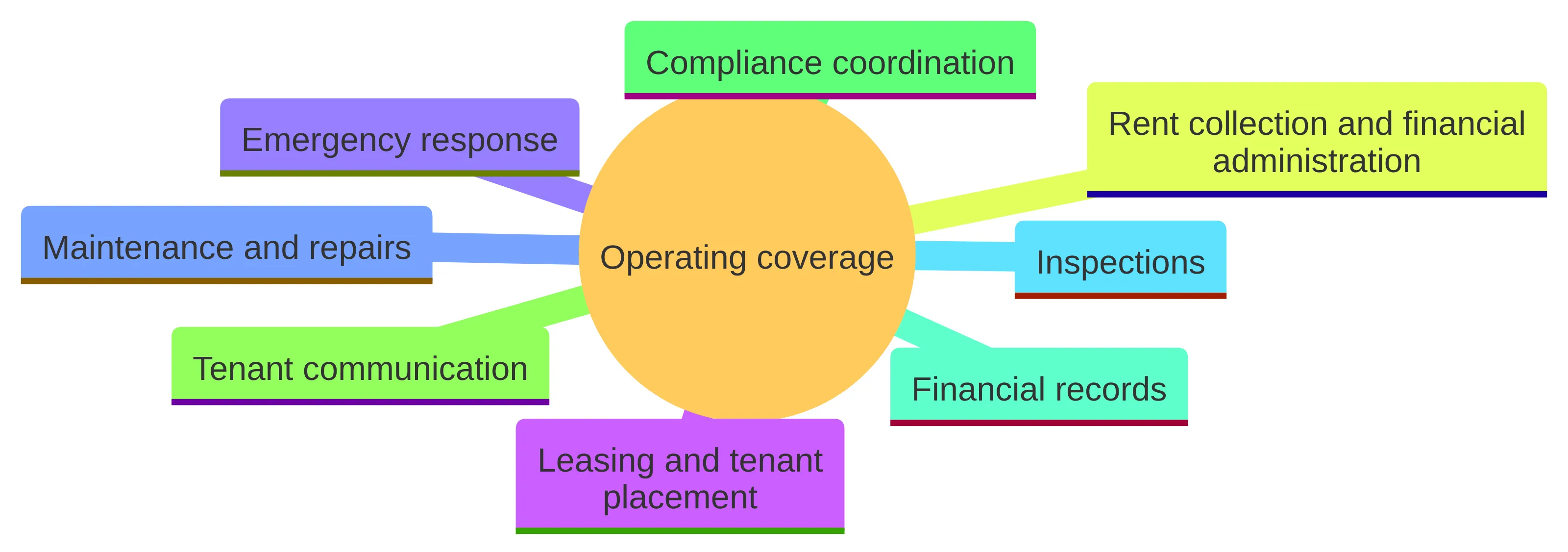
Professional property management commonly covers leasing activity, rent collection, maintenance and repairs, financial records, inspections, emergency response, and tenant communication. Those categories give you a practical starting point for evaluating coverage, but the same category can mean different things from one agreement to another. A manager may coordinate repairs without setting approval limits, collect rent without explaining reconciliation, or handle leasing without making the tenant-placement process clear.
Treat each category as a responsibility that needs a visible boundary. Ask what the manager does, what you still do, what requires your approval, what is recorded, and how you are notified. That approach keeps the discussion tied to operations rather than to labels or broad assurances.
Describe the property before comparing managers
A property description should give a prospective manager enough context to discuss operating fit without guessing. Start with the asset itself, then add the conditions that affect leasing, maintenance, communication, and reporting.
Prepare these details:
- Property type: single-family home, duplex, apartment building, mixed-use building, or commercial space.
- Location: city, neighborhood, access constraints, parking conditions, and any distance that affects inspections or vendor visits.
- Unit count: number of occupied, vacant, and owner-occupied units, if applicable.
- Building condition: recent improvements, deferred work, recurring repair issues, major systems, and features that need specialized care.
- Occupancy and leasing position: current leases, upcoming expirations, vacancies, concessions, furnished or unfurnished status, and marketing needs.
- Ownership structure: individual ownership, partnership, trust, or another arrangement that affects approvals and reporting recipients.
- Operating preferences: spending thresholds, preferred contractors, approval process, inspection expectations, and how often you want updates.
- Tenant-service requirements: ordinary requests, urgent repairs, after-hours contact needs, and communication channels already in use.
A high-value property can be difficult to operate even when the building is small. A larger property can have more units but a more repeatable maintenance pattern. Location may matter as much as finish quality: San Francisco operations, a Peninsula property, and a building farther from your normal travel route can create different coordination needs.
Describe the work rather than relying on adjectives. “Older building with recurring plumbing issues and two vacant units” gives a manager something to evaluate. “Luxury property” leaves too much unsaid.
Operational complexity should be visible before a provider discusses a management arrangement. List the work that has required your attention during the past year, including routine tasks and disruptions. Include maintenance requests, vendor access, lease renewals, vacancy preparation, rent follow-up, owner approvals, insurance documentation, and tenant communications where those items apply.
Separate recurring work from exceptional work. Recurring work may include monthly accounting review, regular inspections, landscape coordination, or rent collection. Exceptional work may include a water intrusion, a major appliance replacement, a turnover, or a dispute requiring professional advice. This distinction helps you ask whether a manager has a process for ordinary operations and a defined boundary for matters that need escalation.
Your property brief should also identify what you do not want delegated. You may want to retain approval of capital work, choose a design direction, or receive notice before a vendor enters a unit. A clear boundary makes a later scope comparison more useful because you can distinguish a service gap from a responsibility you intentionally kept.
Evaluate the operating coverage a high-value rental requires
A management scope should connect each operational need to an accountable process. In San Francisco, property managers may coordinate tenant relations, rent collection, compliance, maintenance, repairs, and marketing. General property-management practice also includes leasing, tenant screening, lease administration, financial records, inspections, and emergency response. Use those categories as a checklist, then ask how the provider handles the version of each task your property requires.
Leasing and tenant placement deserve more than a marketing description. Ask how the manager prepares the unit, describes the property, handles inquiries, coordinates showings, processes applications, and moves from an approved applicant to a signed lease. If the property has distinctive finishes, unusual layouts, or rules affecting use, ask how those details are communicated accurately. You should also understand which leasing decisions remain subject to your approval and how a vacancy is tracked from notice through occupancy.
Maintenance and repairs need a similar breakdown. Ask how routine requests enter the system, how access is arranged, how vendors are selected or assigned, how estimates are handled, and how completed work is recorded. A property with older systems or specialized finishes may need a different maintenance plan from a recently renovated unit. Ask how recurring problems are identified and how a repair becomes a larger planning issue rather than another isolated work order.
Rent collection and financial administration should be described in operational terms. Ask how rent is collected, how missed payments are communicated, how records are reconciled, and what owner-facing information you receive. Do not assume that collecting rent and reporting on the property are the same function. Your questions should connect the transaction record to the owner report and to any action that needs your approval.
Tenant communication is part of the operating coverage, not a separate courtesy. A clear communication system should give you regular financial reporting and updates about leasing, maintenance, and risk issues, while giving tenants defined request channels and emergency procedures. Ask how ordinary messages differ from urgent requests, how acknowledgments are handled, and how unresolved issues are escalated.
A useful service discussion should answer these questions:
- Where does a tenant submit a maintenance request?
- How are urgent conditions distinguished from routine repairs?
- Who receives a request outside ordinary business hours?
- What information reaches you when a repair affects cost, access, habitability, or scheduling?
- How are tenant communications and completed work documented?
- What happens when a tenant cannot provide access or a vendor cannot complete the assigned work?
The goal is not to demand a particular channel. The goal is to make the handoffs visible. A portal, phone line, text process, email system, or combination can be evaluated by the same criteria: defined ownership, a usable record, a clear escalation path, and information that reaches the right person.
High-value rentals also require an explicit boundary between coordination and professional judgment. A manager can organize inspections, repairs, leasing steps, records, and communications without replacing an attorney, tax adviser, insurance professional, architect, engineer, or other specialist. Ask where the manager coordinates with outside professionals and where you must obtain separate advice.
Use a coverage worksheet with one row for each responsibility. For every row, record the manager’s stated role, your retained role, the approval trigger, the record you will receive, and the escalation route. A worksheet helps you compare proposals on actual work rather than on a general promise to provide full-service management.
Test reporting and communication before requesting a proposal
Property-management reporting should let you understand both the money and the work. A useful report can cover rental income, expenses, management fees, maintenance costs, owner distributions, account balances, lease activity, and property updates. Use that list to ask what you will receive, how often you will receive it, and whether the report connects financial entries to the underlying activity.
Ask for a description of the reporting cycle rather than accepting the word “transparent.” Your questions can include:
- What period does each report cover?
- How are rent, expenses, fees, and maintenance costs separated?
- How are owner distributions and account balances shown?
- How are lease changes and vacancies reflected?
- How do property updates connect to invoices, work orders, or approval records?
- Who answers a question about a transaction, and how is a correction documented?
A reporting system should support decisions. If an expense needs approval, you should know when that approval is requested. If a vacancy changes the operating picture, you should be able to identify the related activity. If maintenance costs recur, the record should make that pattern easier to discuss.
Owner communication should have a schedule and an exception path. Regular updates can address leasing, maintenance, financial activity, and issues that need your attention. The exception path should explain what happens when a matter is urgent, disputed, unusually costly, or outside the manager’s authority.
Tenant communication needs its own test. Ask whether tenants have a defined way to submit requests, whether urgent matters follow a different path, and how the manager records acknowledgments and follow-up. A process that works for owner reports may not work for an active maintenance request, so evaluate the two communication streams separately.
Before asking for a formal proposal, request a sample reporting outline or a walkthrough of the information flow if that is available. You are not trying to judge presentation style alone. You are checking whether the proposed system would let you identify what happened, what needs a decision, and what remains open.
Use a short communication test during an introductory discussion. Give the provider three hypothetical situations: a routine repair, an approaching lease expiration, and an unexpected cost that needs approval. Ask who acts first, what you receive, when you receive it, and where the record lives. The answers should distinguish routine handling from escalation instead of placing every situation in the same general inbox.
Also ask how communication works when you are unavailable. A property plan should identify who can authorize ordinary work, how limits are recorded, and how unresolved decisions are brought back to you. Those details matter for a property with tenants, vendors, multiple units, or time-sensitive leasing work.
Check Bay Area compliance coordination without outsourcing judgment
San Francisco rental-property operations are subject to local rent-control and tenant-rights rules, so compliance coordination belongs in your management evaluation. The scope of that coordination should be specific. Ask which records the manager maintains, which notices or lease processes it coordinates, what local rules affect the property, and which matters are referred to qualified professionals.
A prospective manager should not treat “compliance” as a complete answer. Ask for the practical boundary:
- Which routine compliance tasks are included in the proposed scope?
- Which decisions require your approval or separate legal advice?
- How are rule changes or property-specific questions brought to your attention?
- What records support notices, tenant communications, repairs, and approvals?
- How are complaints or potential disputes escalated?
The San Francisco Rent Board provides a Housing Inventory and Fee Portal for property reporting and annual Rent Board fees. The cited Rent Board guidance says residential property owners must report into the Housing Inventory online through the Rent Board Portal. If your property falls within that requirement, ask who coordinates the relevant administrative work and what remains your responsibility. Confirm the applicable current rule for the property before relying on a general checklist.
California guidance says a housing provider must take reasonable steps to promptly correct and end known or reasonably knowable unlawful discriminatory harassment when the provider has the power to act. That principle makes tenant communication and escalation more than an administrative detail. Ask how a manager receives reports, records the issue, escalates it, and coordinates an appropriate response within its authority.
Do not ask a management provider to replace your legal judgment. Ask the provider to identify its operating role, its communication process, and the point at which qualified legal advice is needed. That boundary helps you evaluate responsibility without treating a management agreement as a substitute for advice about a specific dispute, notice, lease, or property condition.
Relate The Housing Guild’s documented scope to the fit test
At The Housing Guild, we provide owner-centric property-management services for San Francisco Bay Area owners. We manage Bay Area buildings for owners with leasing, compliance, maintenance, and accounting in the documented scope, and we offer leasing and tenant-placement services for Bay Area rental owners.
Relate that scope to your property brief rather than assuming that a broad category answers every operational question. If your property needs leasing support, ask how the tenant-placement process would apply to the unit type, location, condition, and timing you described. If maintenance and compliance coordination are central concerns, ask how those responsibilities would be assigned and recorded. If accounting is part of your requirements, ask what owner-facing reports and approval records would be included in the proposed arrangement.
The Housing Guild’s Bay Area scope is relevant to an owner evaluating a San Francisco or nearby property because location is part of the operating fit. It is still your responsibility to describe the asset accurately and identify the work that needs coverage. A service category becomes useful only when it can be connected to the property’s actual responsibilities.
We offer an Online Owner Portal that helps asset holders manage investment-related communication, and our Online Owner Portal provides real-time insights and facilitates communication related to maintenance management. Our Online Owner Platform also helps property owners organize and update maintenance tasks.
Use those documented portal functions as prompts for your own questions. Ask how maintenance information is entered, updated, reviewed, and connected to owner communication. Ask what information you can access, how an open task is distinguished from completed work, and how a question about a cost or status is handled. The practical test is whether the system supports the reporting and communication requirements you identified, not whether the portal name sounds extensive.
The Housing Guild also offers integrated messaging and notification tools for property-management communication. Ask how those tools relate to tenant requests, owner updates, and escalations. Your goal is to map the stated scope to the rows in your coverage worksheet and mark any item that still needs clarification.
We offer a free proposal for our property-management services.
A proposal is useful when it responds to a defined property brief. Before requesting one, identify the property type, location, unit count, condition, current occupancy, leasing needs, maintenance concerns, reporting expectations, and tenant-communication requirements. Then ask that the response distinguish included responsibilities, approval points, retained owner duties, and matters requiring outside professional advice.
This keeps The Housing Guild’s documented scope connected to your decision rather than treating the brand name as the decision itself. You can compare the response against the same worksheet you use for any other provider, with particular attention to Bay Area coordination, reporting, maintenance communication, leasing, compliance responsibilities, and accounting.
Build a control map for a high-value Bay Area rental
Luxury property management is not a complete service description. For this evaluation, treat “luxury” as a shorthand for a high-value rental whose location, condition, property type, unit count, or operating complexity may require a more exact service discussion—not as a fixed property classification or a promise of higher returns. For a property in San Francisco or another Bay Area market such as Atherton, Menlo Park, Redwood City, or Los Altos, build a control map around six areas:
- Asset and access: location, property type, unit count, approximate age, distinctive features, mixed-use or commercial components, and access conditions.
- Condition and maintenance: recent improvements, deferred maintenance, recurring repairs, major systems, inspection history, and scheduled work.
- Leasing and resident operations: occupancy, lease dates, vacancies, pending renewals, the current rent-collection process, and known tenant-service issues.
- Authority and workload: vendor relationships, inspection preferences, approval thresholds, tasks you currently handle, and decisions you expect to retain.
- Owner reporting: rental income, expenses, fees, maintenance costs, distributions, balances, lease activity, property updates, update frequency, document access, and communication recipients.
- Local coordination and transition: known San Francisco requirements, open notices or disputes, recordkeeping needs, existing leases and files, vendor contracts, keys or access systems, and the date by which responsibilities may change.
Separate observations from assumptions. If you do not know how often a repair occurs, mark it unknown and ask how the manager would establish a baseline. If a building condition has not been inspected, record the observed issue rather than a diagnosis. Mark each control as known, unknown, owner-retained, or requiring a question; the resulting map shows where a service discussion needs more precision.
Use questions that expose responsibility, records, and decision points. A long list is less useful than a focused list tied to your property.
Ask:
- Which leasing and tenant-placement tasks are included from vacancy through move-in?
- How are maintenance requests submitted, triaged, assigned, tracked, and closed?
- What happens when a repair exceeds an approval limit or reveals a larger building issue?
- How are rent collection, financial records, fees, maintenance costs, and owner distributions reported?
- What updates do you receive about lease activity, vacancies, maintenance, and risks?
- Which tenant communication channels are available, and how are urgent matters escalated?
- Which San Francisco or Bay Area compliance tasks are coordinated, and which remain with you or a qualified adviser?
- What property records are needed before management begins?
- How are existing vendors, leases, tenant communications, and open work orders transferred?
- What responsibilities remain yours after the manager begins operating the property?
Record the answer to each question in your coverage worksheet. Mark answers as included, conditional, excluded, or unresolved. That simple classification prevents a broad statement from being mistaken for a confirmed responsibility.
Compare proposals by operational fit rather than by one headline number. Review whether each response addresses the same property facts, names the same responsibility boundaries, and explains the same reporting and communication needs. A lower apparent cost may not represent the same scope if leasing, inspections, emergency coordination, accounting, or owner reporting are handled separately.
Look for gaps that require a direct follow-up:
- A service is named but the process is not described.
- A responsibility is described without an approval boundary.
- A report is promised without its contents or timing.
- Tenant communication is discussed without an emergency route.
- Compliance is mentioned without distinguishing coordination from legal advice.
- Maintenance is included without explaining records, access, vendor handling, or escalation.
Do not fill a gap with an assumption. Carry the question forward until the scope is clear or mark that responsibility as retained by you.
Request a proposal when the documented fit is clear
A management decision is ready for the next step when your property brief, coverage worksheet, and unanswered questions point to a defined operating fit. You should be able to explain the property’s type, location, condition, unit count, leasing position, maintenance workload, reporting needs, and tenant-communication requirements. You should also know which decisions you will retain and which responsibilities you want assigned.
Use this final readiness check:
- The asset and its operating complexity are described without relying on the luxury label.
- Leasing, repairs, maintenance, rent collection, accounting, compliance coordination, reporting, and tenant communication have clear responsibility boundaries.
- Owner updates and tenant requests have defined channels and escalation paths.
- San Francisco requirements have been identified for confirmation where they apply.
- The prospective manager’s Bay Area scope has been related to the property rather than assumed to fit every asset.
- Open questions are written down instead of being treated as included.
A qualified professional should decide individual legal, tax, investment, or property-specific suitability. Your role in this evaluation is to make the operating facts and requested responsibilities clear enough for an informed discussion. When the documented fit is clear, submit the configured request for a free property-management proposal; the request does not confirm an agreement or appointment.
Owner Resources
Want The Housing Guild to handle this for you?
We manage San Francisco Bay Area buildings for owners — leasing, compliance, maintenance, and accounting. Get a free proposal, or explore the service.