
luxury property management
Luxury Property Management in San Francisco: A Proposal-Readiness Decision Guide

Triage the Property’s San Francisco Operating Exposure
Start with a three-part operating-risk triage for a San Francisco-area high-end rental. First, list the property’s conditions: type, location, size, systems, amenities, access, occupancy pattern, and any advanced technology, substantial acreage, difficult access, or environmental exposure. These features can indicate where additional oversight may be needed; they do not establish that a provider offers it.
Second, list recurring administration: market preparation, tenant screening, rent collection, repairs and maintenance, and adaptation to local laws and regulations. Third, flag coordination that may extend beyond those baseline tasks, including specialized vendors, household staff, or services linked to the property’s features. Luxury property management is often defined by personalization, precision, and stewardship of complex, high-value properties, but a category label does not define a provider’s actual scope.
Turn the triage into a property operating control record. Give each demand one row with five fields:
- Property demand: the feature, recurring task, or local operating issue.
- Control needed: the action or coordination the demand appears to require.
- Accountable party: the owner, manager, vendor, or another participant.
- Decision boundary: what needs owner approval and what can proceed within the agreed scope.
- Proposal proof: the description, service level, fee treatment, or reporting detail the provider must confirm.
For example, a specialized system belongs in the record as a demand to describe and assign, not as proof that a prospective manager maintains it. The same applies to leasing, rent collection, repairs, maintenance, tenant communication, and local-law administration: list the work, assign responsibility, and require the proposal to state how the work will be handled. Any luxury-specific service, price, timeline, or outcome remains a question for the property-specific proposal.
Your first decision is therefore conditional: seek professional management when the property’s coordination burden, local operating requirements, or owner availability make a defined outside scope useful. Do not choose a provider simply because it uses a premium-sounding category. Prepare a short property brief and judge whether a provider can respond to the actual work.
Classify Property Features by the Control They Require
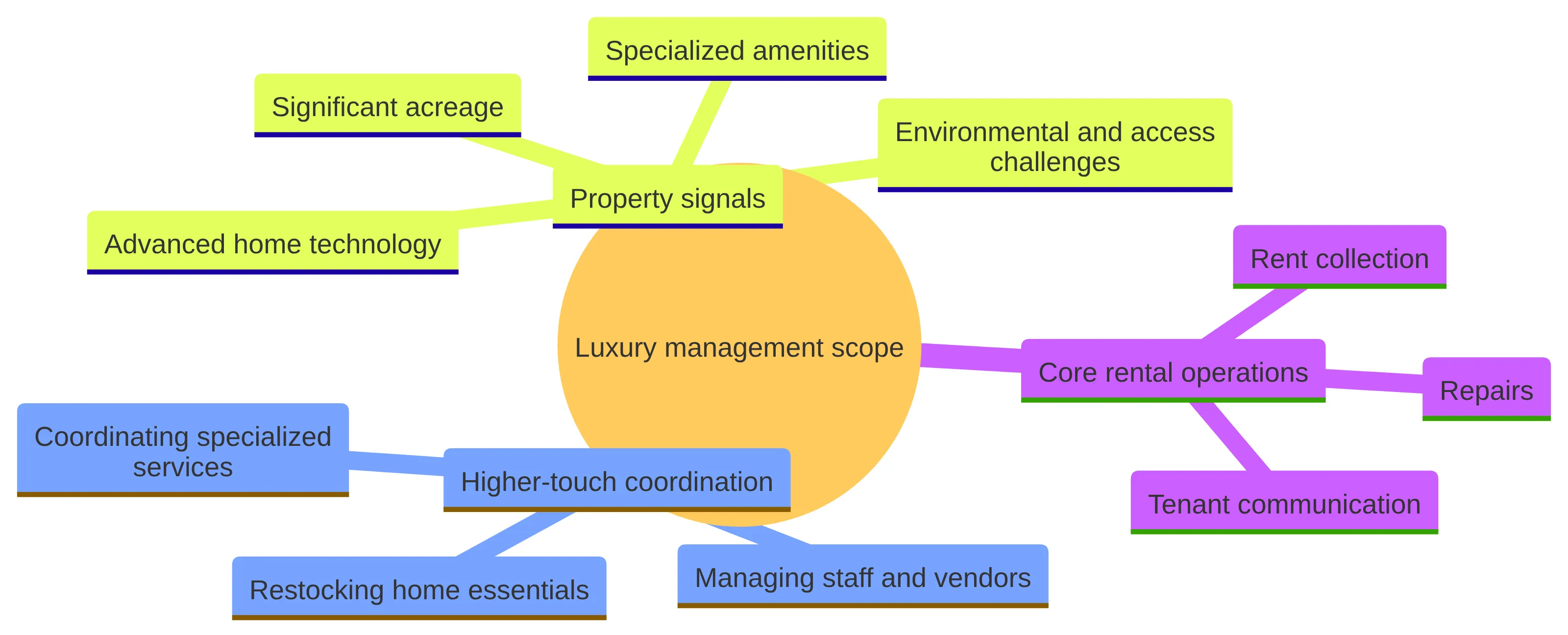
Classify each feature by the control it creates, rather than by how premium it sounds. Traditional property management commonly includes rent collection, repairs, and tenant communication. Depending on the property, higher-touch management may extend to restocking essentials, managing staff and vendors, and coordinating specialized services.
For each feature, record the operating consequence: a recurring task, a handoff, an approval decision, or a specialist dependency. A high-end San Francisco residence may need one kind of coordination, while a larger property with unusual access conditions or several specialized systems may need another. The provider’s role is only one entry in the map; the feature, trigger, and resulting record also need to be defined.
Your property may warrant questions about higher-touch coordination when it includes:
- Advanced home technology that requires a defined maintenance or vendor process.
- Specialized amenities whose upkeep differs from ordinary residential maintenance.
- Substantial acreage, multiple structures, or access conditions that affect inspections and service visits.
- Environmental conditions that may complicate routine care or vendor access.
- Household staff, recurring service providers, or owner-selected vendors whose responsibilities need to be coordinated.
- A service standard that includes more than collecting rent, responding to repairs, and communicating with occupants.
The presence of one feature does not establish that a particular provider can manage it. Treat each signal as a question for the proposal: who handles the work, how often, under what approval limit, and what record comes back to you?
Your scope should distinguish three layers of work. Core administration covers recurring rental tasks such as rent collection, tenant communication, maintenance coordination, and financial records. Property-specific operations cover the systems, amenities, access arrangements, and vendor relationships that make your home different from a standard rental. Owner preferences cover the response times, approval practices, reporting format, and service details you want documented.
This three-layer distinction keeps the conversation practical. It also prevents a provider from treating every premium feature as an undefined promise. Ask for a written response to each layer, then mark any item that depends on a third party, a separate fee, owner approval, or a specialist.
Assign Each Operating Handoff to an Accountable Party
Start the control map with ordinary rental operations. San Francisco property management may cover market preparation, tenant screening, rent collection, repairs, maintenance, and adaptation to local laws and regulations. Traditional management also commonly includes tenant communication. These are the baseline entries against which property-specific coordination should be recorded.
Complete each baseline entry with the event that starts it, the person or party that handles it, and the record that closes it. For example, note how a maintenance request enters the system, who decides whether a vendor is needed, how rent activity appears in owner records, and how tenant communications are preserved. This keeps presentation, concierge-style attention, and specialized amenities from standing in for the operating base.
Higher-touch coordination changes the number and type of handoffs, not merely the tone of the service. Restocking, staff management, vendor management, and specialized services may involve people who are not tenants, owners, or ordinary repair contractors. Each handoff creates a responsibility question:
- Who schedules the work?
- Who checks that the work was completed?
- Who approves the cost?
- Who communicates a delay?
- Who keeps the invoice, service note, or completion record?
- Who decides when a specialist is required?
These questions are practical tests. They do not assume that every provider should perform every task. They ask the provider to distinguish work it performs from work it coordinates and work that remains with you.
Your service comparison should keep ordinary operations and higher-touch coordination in separate rows. Mark a row as included, available subject to conditions, handled by a third party, or owner responsibility. If a provider uses a broad phrase such as full-service management, ask it to translate that phrase into the rows that affect your property. Proceed only when the responsibilities, approvals, and records are clear enough for you to compare providers on the same basis.
Build the Property’s Operating Control Record
Build the property record before you build a provider comparison. A proposal guide recommends specifying whether a property is residential, commercial, or mixed-use because property type affects administration strategies and required expertise. Luxury-related features may also include advanced technology, specialized amenities, substantial acreage, or environmental and access challenges.
Use the record to show which conditions create work, which create access or approval constraints, and which need specialist input. A short, accurate description gives each provider the same starting point without deciding in advance that a feature belongs in a standard package.
Your property brief should include:
- Property type: single-family home, condominium, apartment building, mixed-use property, or another form of residential asset.
- Location and access: city, neighborhood, parking or entry conditions, distance from your usual location, and any restricted access periods.
- Physical scope: number of units or structures, approximate size, outdoor areas, storage, and shared spaces.
- Systems and amenities: technology, mechanical systems, specialty installations, pools, landscaping, security arrangements, or other features that need regular attention.
- Occupancy and leasing status: occupied or vacant spaces, lease timing, turnover history, furnished or unfurnished use, and any existing vendor or staff relationships.
- Operating history: recurring repairs, unresolved work, seasonal pressure, tenant communication issues, and records that need to be organized.
- Owner preferences: spending approvals, inspection expectations, reporting format, communication channels, and the decisions you want to retain.
Use facts you can support with leases, invoices, inspection notes, vendor records, and your own operating history. Avoid turning assumptions about the property into requirements before checking them.
Your provider-fit test should compare the property brief with the provider’s stated experience and proposed responsibilities. Ask whether the provider handles the same property type, works in the same location, coordinates comparable systems or vendors, and has a process for the volume of communication your property creates. Ask for a separate answer when a task requires a specialist.
A provider does not need to match every feature through its own staff. It does need to explain the handoff. Record the name of the responsible party, the approval point, the expected record, and the condition that could change the arrangement.
Trace Maintenance From Report to Record
Trace one maintenance issue through the control map rather than accepting a general maintenance label. San Francisco property management may include repairs and maintenance, and The Housing Guild’s Online Owner Portal helps property owners organize and update maintenance tasks. Use those supported functions as entries in the map while keeping the broader response property-specific.
For a sample issue, record how a tenant, owner, or vendor submits it; how urgency is classified; who can authorize work; how access is arranged; how completion is recorded; and how recurring problems are brought to your attention. The resulting trail shows where responsibility and information change hands.
Your emergency checklist should separate response coordination from technical judgment. A provider may receive a report, contact the appropriate party, communicate with occupants, and record the event, while a licensed or specialized contractor may diagnose and perform the work. Ask the provider to identify that boundary rather than assuming that a management team performs every repair.
Use these questions:
- What events count as urgent under the proposed process?
- Who receives the report outside ordinary office hours?
- What immediate communication goes to you and the occupants?
- What spending authority applies before owner approval?
- Which specialists or vendors may be called?
- What record will show the report, response, cost, and completion status?
- How are unresolved or repeated issues escalated?
The Online Owner Portal can help organize and update maintenance tasks, while integrated messaging and notification tools can support property-management communication. Ask to see how those functions would be used for your property rather than treating a portal name as proof of a particular response commitment.
Your maintenance decision should remain conditional until emergency definitions, approval limits, vendor responsibility, communication channels, and records are written down. A provider that cannot describe those conditions has not yet shown how its general maintenance scope would fit a distinctive property. Keep specialist work, insurance questions, building-system decisions, and legal obligations in the appropriate professional lane.
Trace Leasing, Placement, and Rent Controls
Map leasing and tenant placement as an occupancy sequence. San Francisco property management may include preparing a property for market, finding and screening tenants, and collecting rent. A proposal guide recommends listing the services needed, including tenant screening, maintenance, rent collection, and financial reporting, so a provider can tailor its response.
Record the transition from a vacant or soon-to-be-vacant property to an executed lease: preparation, listing information, inquiries, screening criteria, communication, application handling, lease execution, move-in records, and the handoff into ongoing management. If the property has distinctive finishes, systems, furnishings, or access arrangements, add the accuracy checks needed to represent them without creating unsupported expectations.
Rent collection should be connected to a reporting routine. Ask when rent activity is recorded, how unpaid amounts are identified, what communication follows a missed payment, and where you can see the resulting ledger or statement. The provider should also explain which administrative steps it handles and which decisions remain with you or require separate legal guidance.
Your rent-collection questions should include:
- What payment channels are available to tenants?
- When do owner records reflect a payment, charge, adjustment, or unpaid balance?
- How are recurring charges and approved expenses identified?
- Who communicates with a tenant about a missed payment?
- What information appears in the owner report?
- Which steps depend on the lease, local rules, or a professional decision outside ordinary administration?
Your leasing evaluation should distinguish process quality from an outcome promise. Ask for the steps, responsible party, approvals, records, and conditions. Do not treat a statement about quick leasing, premium tenant demand, or a particular rental result as established until the provider gives property-specific terms and you understand the assumptions behind them.
A suitable provider should be able to discuss both the public-facing presentation of a higher-end home and the less visible administration that follows. Choose based on the complete chain, from market preparation through tenant communication and rent records.
Build Owner Visibility Into the Operating Record
Build visibility into the map rather than treating reporting as a separate promise. A proposal guide identifies financial reporting as a service that should be listed explicitly when requesting a response. The Housing Guild offers an online Owner Portal to help owners organize communication and manage their investments.
For each operating row, mark the statement, record, notice, approval, maintenance update, or message that should make activity visible. Ask how information is organized, how corrections are handled, and what remains available for later review.
Your reporting test should follow a single issue across the operating record. For example, trace a maintenance request from submission to assignment, approval, completion, invoice, and owner statement. Then trace a tenant communication from the original question to the response and any follow-up. The point is not to demand a particular software arrangement. The point is to see whether the information you need can be found and understood.
The Housing Guild’s Online Owner Portal helps property owners organize and update maintenance tasks, and integrated messaging and notification tools support property-management communication. Ask how those functions connect to your reporting expectations, who updates them, and which records are retained.
Your owner-communication checklist should cover:
- Cadence: when routine statements, maintenance updates, and notices arrive.
- Content: which income, expense, tenant, work-order, and approval details appear.
- Access: how you view records and communicate with the management team.
- Escalation: which events trigger immediate contact rather than routine reporting.
- Decision rights: which actions proceed under standing authority and which require your approval.
- Correction process: how an inaccurate or incomplete record is amended.
A portal can improve access to information, but access is not the same as a defined reporting obligation. Put the report contents and communication conditions into the proposal or agreement.
Turn the Control Map Into a Proposal Comparison
Price the mapped work, not the luxury label. A selected RFP guide offers a planning reference for residential property-oversight fees, but it does not establish a current quote for your property. Treat that reference as planning context only; actual fees require a current, property-specific proposal.
Once the map is filled, attach a charge to each responsibility. Separate recurring, event-based, pass-through, optional, and prior-approval costs, including leasing, setup, inspections, project coordination, vendor markups, after-hours handling, specialist coordination, and vacant-period costs.
Your fee worksheet should include:
- The management fee and the amount to which it applies.
- Leasing, renewal, placement, or turnover charges.
- Maintenance coordination, inspection, project, or emergency-related charges.
- Vendor pricing, administrative additions, and pass-through expenses.
- Owner approval thresholds and permitted spending without advance approval.
- Accounting, statement, payment, or document fees.
- Charges that continue during vacancy or while work is underway.
- Termination terms, transition records, and responsibilities at handoff.
Use the same rows for every proposal. A lower percentage may not be lower in total if more work sits outside the base scope, while a higher percentage may reflect a broader defined responsibility. Neither conclusion can be made until the proposal identifies the work and conditions.
Your responsibilities should be listed beside the provider’s responsibilities. You may retain decisions about capital work, insurance, tax matters, legal strategy, specialist appointments, spending approvals, or property improvements. The provider should identify where it coordinates those matters and where it stops.
Ask how the arrangement handles owner delays, unavailable vendors, disputed invoices, tenant claims, access problems, and work that exceeds the ordinary maintenance budget. Those questions do not imply that a provider must accept every risk. They make the handoff visible before you compare the price.
Treat California compliance as a verification question
California compliance should appear as a defined verification row in your management brief, not as a general promise that a provider handles regulations.
Your proposal questions should ask how the provider records the relevant lease dates, presents the offer, tracks the annual timing, preserves the tenant’s response, and reports completion to you. The answer should also identify which step belongs to the owner, which step the provider administers, and which reporting agency or process is involved if applicable.
San Francisco operations can also require attention to local rental rules and changing regulatory conditions. A provider’s local experience may help organize the administrative work, but a general service description does not resolve a property-specific legal question. Ask the provider to identify the compliance tasks included in its management scope and the events that trigger escalation or outside counsel.
Keep a dated compliance register with the lease, notice, reporting, inspection, and communication items relevant to your property. When a rule, lease term, or dispute changes the conclusion, obtain the appropriate current professional guidance rather than relying on a marketing description.
Your compliance decision rule is simple: include each known obligation in the proposal questions, require a clear administrative role, and mark unresolved legal interpretation as unresolved. Do not treat a provider’s acceptance of routine management work as a representation that every legal obligation has been reviewed or resolved.
Distinguish documented Housing Guild scope from unconfirmed luxury capability
We offer leasing and tenant-placement services for Bay Area rental owners. We offer an online Owner Portal to help owners organize communication and manage their investments, and our Online Owner Portal helps property owners organize and update maintenance tasks. We also offer integrated messaging and notification tools to support property-management communication.
These services give you a supported starting point for evaluating leasing, owner communication, maintenance records, and routine coordination. They do not by themselves establish that every luxury-specific service is included for every property. The property brief and proposal still need to define the work, conditions, approvals, and outside specialists.
We have been managing Bay Area buildings since 1977. That local operating history is relevant when you are evaluating a San Francisco-area rental, but it does not replace a property-specific scope review. Use it as a reason to ask detailed local questions, not as a conclusion that every building, amenity, vendor arrangement, or service level will be handled in the same way.
Your proposal should separately address luxury-specific capabilities that remain unconfirmed until the provider addresses them. Ask about:
- Restocking household essentials.
- Managing household staff or existing service teams.
- Coordinating specialized services.
- Maintaining advanced home technology or unusual amenities.
- Handling substantial acreage, multiple structures, or difficult access.
- Responding to environmental conditions that affect routine care.
- Meeting owner-defined standards for inspections, presentation, communication, and approvals.
The possibility of a service is not proof that the service is included. For each item, ask whether we perform it, coordinate it, refer it to a specialist, or leave it with you; whether a separate charge applies; what information we need; and what record you receive.
We offer a free, no-obligation property-management proposal; submitting a request does not confirm an agreement or appointment. Use the proposal process to ask for a response tied to your property type, location, systems, leasing status, maintenance history, reporting needs, and compliance questions. A useful response should let you distinguish the services we offer from capabilities that require separate confirmation, specialist involvement, additional cost, or an owner decision.
Use a provider-fit decision rule
Your provider-fit decision should rest on coverage of defined responsibilities, not on a category label or a fee percentage alone. Compare each option against the same property brief and the same operating rows. The following table gives you a practical structure for that comparison.
| Decision criterion | Self-management | Internal coordinator or existing team | Professional property manager |
|---|---|---|---|
| Core rental administration | You handle tenant communication, rent activity, records, and follow-up | Your team handles the work within its assigned capacity | The proposed scope identifies which administration the manager handles |
| Maintenance and vendors | You arrange intake, approval, access, and records | Your team coordinates vendors and escalates gaps | The proposal identifies intake, approval limits, vendors, records, and escalation |
| Higher-touch property needs | You coordinate staff, specialists, amenities, and access | Your team coordinates them if it has the required capacity | The provider identifies included, conditional, specialist, and owner responsibilities |
| Owner visibility | You assemble statements and operating records | Your team provides the reports it has agreed to provide | The proposal identifies statements, portal access, notices, and communication cadence |
| Local and California administration | You track applicable obligations and deadlines | Your team performs the assigned tracking | The provider identifies administrative support and boundaries, while unresolved legal questions remain separate |
| Workload and decision control | You retain control and the full coordination burden | You retain control through internal delegation | You delegate defined work while retaining the approvals listed in the agreement |
Your decision can follow three outcomes:
- Proceed to a proposal when the property brief shows recurring coordination, local administration, owner-availability limits, or higher-touch work that you want assigned to a provider.
- Request clarification first when the provider appears relevant but leaves fees, emergency handling, specialist work, reporting, or owner approvals unclear.
- Keep or redesign self-management when you can handle the defined workload and the provider’s proposed scope does not solve a specific operating gap.
Choose the first outcome only when the provider can connect its scope to your property and identify the conditions that would change the arrangement.
Prepare the proposal request
Your proposal brief should give a provider enough information to respond to the property rather than to a generic category. Include:
- Property type, address or service area, unit count or structure count, and approximate size.
- Occupancy, lease timing, tenant-placement needs, and current rent-collection arrangement.
- Systems, amenities, access conditions, vendors, staff, and recurring service requirements.
- Maintenance history, open work, emergency concerns, and expected approval limits.
- Reporting, owner-communication, inspection, and portal expectations.
- California and San Francisco compliance questions that need an administrative response.
- Your preferred start date, owner availability, and decisions you intend to retain.
A proposal guide recommends specifying property type and listing the services you need, such as tenant screening, maintenance, rent collection, and financial reporting. Use that structure, then add the higher-touch questions that arise from your property’s features.
Your next step is justified when you can describe the work you want assigned and the proof you need in return. Compare the response against your brief, mark every included and conditional item, and keep unresolved legal, tax, investment, valuation, and specialist questions with the qualified professional responsible for deciding them. Individual suitability depends on your property and circumstances.
A clear scope gives you something concrete to evaluate: responsibilities, approvals, records, fees, local administration, and the boundaries around luxury-specific work.
Use the completed brief when you are ready to move from general criteria to a property-specific conversation.
What should be confirmed before requesting a luxury-property proposal?
What does luxury property management typically include for rental properties?
Luxury property management often involves higher levels of personalization, precision, and stewardship compared to traditional management. This can include restocking essentials, managing staff and vendors, and coordinating specialized services, depending on the property’s unique features.
How can I assess whether a property management provider is suitable for my luxury rental?
To evaluate a provider, define your property’s specific needs, including its type, location, and unique features. Ask potential providers how they will handle ordinary tasks and higher-touch coordination, and ensure they can connect their proposed services to your property’s requirements.
What should I include in my property brief when requesting a management proposal?
Your property brief should detail the property type, location, size, occupancy status, systems and amenities, maintenance history, and any compliance questions. This information helps providers tailor their proposals to your specific needs.
What compliance considerations should I be aware of when managing a rental property in San Francisco?
In San Francisco, property management must adhere to local rental laws and regulations, including those related to tenant rights and rent control. Ensure that your management provider is familiar with these requirements and can handle compliance tasks effectively.
How does The Housing Guild support property owners in managing their rentals?
The Housing Guild offers comprehensive property management services, including maintenance coordination, tenant placement, and an online Owner Portal for streamlined communication and investment management.
What should I ask a property management provider about their emergency response procedures?
Inquire about how they classify urgent issues, who handles after-hours reports, and what communication protocols are in place for emergencies. Understanding their process will help ensure timely and effective responses to urgent situations.
Owner Resources
Want The Housing Guild to handle this for you?
We manage San Francisco Bay Area buildings for owners — leasing, compliance, maintenance, and accounting. Get a free proposal, or explore the service.