
find property manager
How to Find and Evaluate a Property Manager for Your Rental Property

Start with a candidate-screening record
Choosing a property manager starts with a candidate-screening record, not familiarity or a quoted charge. Use the property type, unit count, location, tenant responsibilities, maintenance burden, leasing needs, reporting expectations, and desired level of involvement to set the questions every candidate must answer. Owners with several rental properties or multiple units, owners who live far from a rental property, and owners who lack time for day-to-day operations may have more reason to evaluate professional management. Those circumstances do not make a particular provider suitable by themselves; they show why a defined comparison is useful. The record should separate what a candidate has documented, what remains unclear, and what falls outside the proposed scope.
Use the record in four passes:
- Set the screen. Record the property brief and mark each duty required, preferred, or owner-retained.
- Log comparable responses. Ask each candidate the same questions about service area, property type, included and excluded duties, contacts, maintenance, documentation, accounting, and charges. Record the supporting material and date for each material detail.
- Apply the thresholds. Advance when the candidate addresses the required location, property type, duties, and accountable contact. Clarify when a required answer or backup arrangement is unclear. Remove when a required area or responsibility has no workable owner.
- Use the proposal to close gaps. Request a property-specific proposal from a candidate that clears the initial screen, then compare its scope and charges with the log.
The output is a documented candidate record: advance, clarify, or remove. A lower quoted charge cannot compensate for a missing responsibility that you still need handled.
A property-management comparison should leave you able to answer one question: can this candidate handle the work your property actually creates, with records and communication that let you remain informed? Compare service area, property types, exclusions, decision-makers, backup coverage, escalation, maintenance practices, documentation, and financial reporting. Property-management accounting should record income and expenses such as rental income, maintenance, repairs, utilities, and management fees. Use the rest of this guide to turn that question into a repeatable record.
Write the property-and-responsibility brief
Your property-and-responsibility brief should describe the asset before you contact candidates. A short, factual brief gives each candidate the same starting point and makes the eventual proposals easier to compare.
Record these details:
- Property identity: city, neighborhood, property type, approximate age if relevant to the work, and whether the property is residential, mixed-use, or commercial.
- Scale: number of units, occupied and vacant units, parking or storage responsibilities, and any shared areas that require attention.
- Operating status: current lease status, upcoming vacancies, active maintenance issues, recurring service needs, and any projects already planned.
- Location and access: where you live relative to the property, who can provide access, and whether local attendance is needed for inspections, repairs, or tenant concerns.
- Tenant-facing duties: rent collection, maintenance requests, notices, communication, inspections, move-in or move-out coordination, and emergency handling.
- Owner-facing duties: statements, invoices, approvals, records, budgets, vendor communication, and updates about unresolved work.
- Leasing duties: advertising, inquiries, showings, applications, screening, lease preparation, and renewal coordination, if those tasks are in scope.
The brief should distinguish work you will keep from work you want delegated. For example, you might retain approval of larger repairs while delegating vendor coordination and routine updates. You might also want leasing support but plan to handle ongoing tenant communication yourself. Write each boundary down instead of assuming that a broad service label includes every task.
Your property-and-responsibility brief should end with a priority list. Mark each duty as required, preferred, or owner-retained. Required duties are gates: a candidate that cannot perform or coordinate them needs a clear alternative before you proceed. Preferred duties can help distinguish otherwise suitable candidates. Owner-retained duties should appear in the responsibility map so you do not pay for a task you intend to keep or overlook a handoff.
Use the brief to request comparable answers. Ask every candidate to address the same unit count, location, property condition, leasing status, and desired duties. If a candidate asks for more information, add that request to your record. Financial visibility belongs in the brief as well: identify which income, maintenance, repairs, utilities, management charges, invoices, and owner payments you expect to see documented. The more precisely you describe the work, the less room remains for a proposal to sound complete while leaving key responsibilities undefined.
Build the candidate evidence log
Build the candidate evidence log at the same time as the provider-neutral list. Search for firms and independent managers that serve the relevant city or county, then open one record for each candidate and screen it against the property-and-responsibility brief. For a Bay Area rental, distinguish San Francisco from nearby service areas such as Atherton, Menlo Park, Redwood City, and Los Altos; a regional label does not by itself show that a candidate works in your city or with your property type.
Record the following for every candidate:
- ;
- property types and unit counts the candidate describes managing;
- services included, services excluded, and duties assigned to the owner;
- relevant local experience and the person responsible for your account;
- communication channels and stated response process;
- maintenance coordination and emergency coverage;
- accounting, statements, invoices, and owner-access arrangements;
- licensing or other credentials that may apply in the property’s jurisdiction;
- the source and date of each material detail you record.
Use the same fields for every record: service area, property types, exclusions, relevant local experience, and the supporting material and date for each detail. Mark each field as documented, unclear, or outside the proposed scope rather than giving one candidate credit for a broad description while demanding proof from another.
A useful shortlist is small enough for consistent interviews and broad enough to expose meaningful differences. Remove a candidate when the service area clearly excludes the property, the property type is outside its stated scope, or a required responsibility has no proposed owner. Keep a candidate in the working list when the information is unclear but potentially workable; mark the gap as a question rather than filling it with an assumption.
Distance also belongs in the initial screen. Owners who live far from a rental property may evaluate management support for issues they cannot address remotely, while owners who live nearby may still need help with time-consuming or specialized duties. The point is not to treat distance as a rule. It is to connect location and availability to the actual work your property requires.
Apply the first screening thresholds
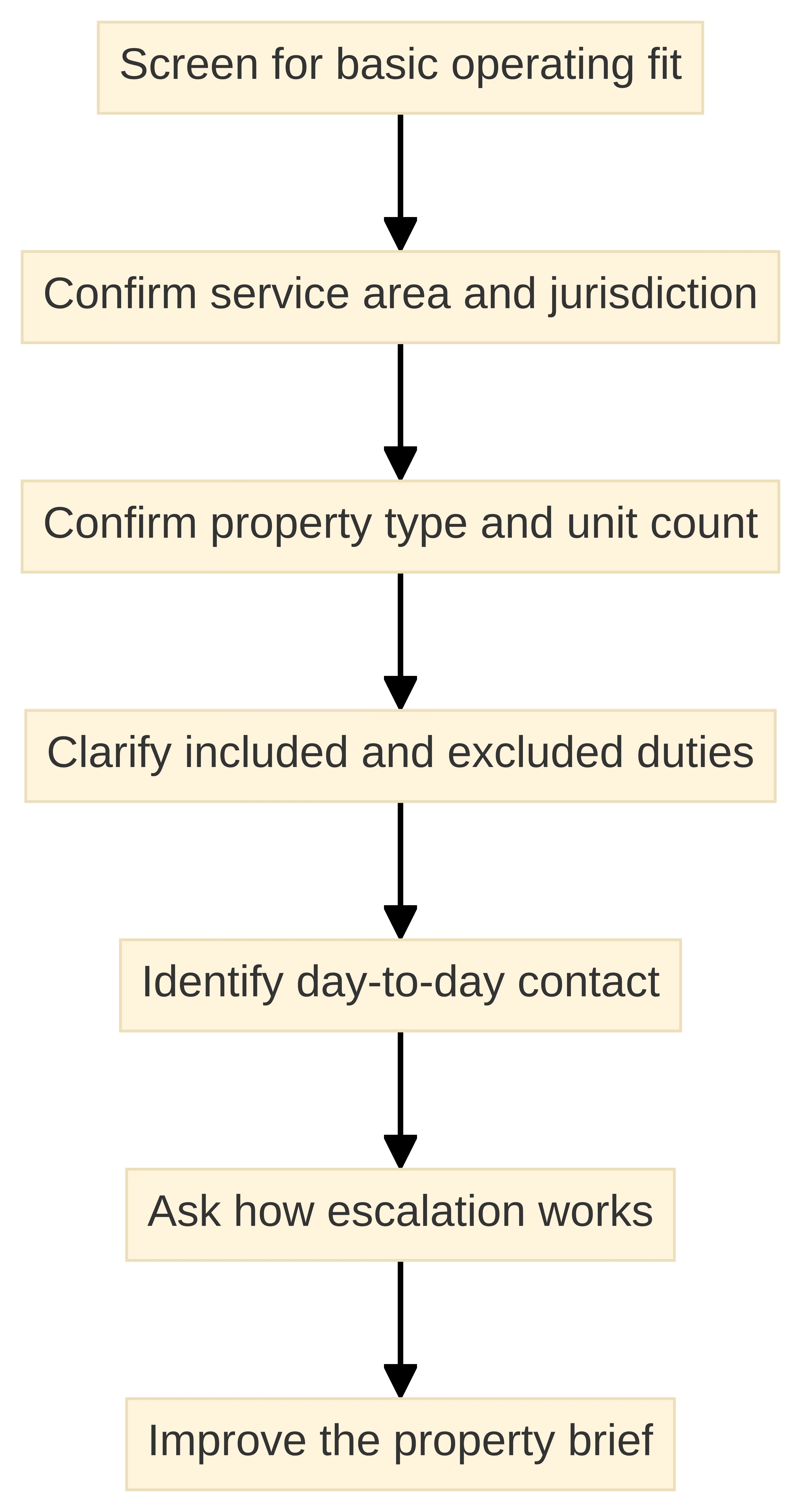
Apply basic operating fit as the first threshold in the candidate evidence log, before comparing presentation, familiarity, or detailed charges. A candidate should be able to explain who would manage the relationship, which property types and locations are within scope, which duties are excluded, and how unresolved issues move from the first contact to a decision-maker. Record each answer as advance, clarify, or remove.
Ask these screening questions in the same order:
- Do you manage properties in the property’s city and jurisdiction? Record the specific service area rather than accepting a general regional label.
- Do you manage this property type and unit count? Note whether the candidate’s experience matches a single-family rental, duplex, apartment building, mixed-use property, or commercial space.
- Which duties are included and which remain with me? Ask for exclusions in writing.
- Who is the day-to-day contact? Record that person’s role, authority, direct access, and backup coverage.
- How does escalation work? Ask who handles an unresolved tenant issue, urgent repair, vendor dispute, or owner concern after onboarding.
- What information do you need before preparing a property-specific scope? Use the answer to improve your brief.
A property manager may operate as a real estate broker managing properties for one or more owners, either independently or through a property-management firm. That description explains possible business structures, not the quality or fit of a particular candidate. Treat credentials, roles, authority, and responsibility boundaries as separate questions.
Your basic-fit screen should produce one of three outcomes for each candidate: advance, clarify, or remove. Advance when the candidate serves the property’s area and type and can identify an accountable operating contact. Clarify when a required duty, backup arrangement, or escalation route is unclear. Remove when the candidate cannot address a required location, property type, or responsibility.
Do not use a polished intake call as a substitute for operating detail. A candidate can communicate well during a sales conversation while leaving the actual post-onboarding decision-maker, coverage plan, and exclusions undefined. Ask for the same basic facts from every candidate, then carry unanswered questions into the next comparison stage.
Match required duties to documented scope
Your duty map should connect each required task to a named accountable party and a record you expect to receive. A service label such as full-service management is not enough to show who handles a particular handoff. Translate the label into tasks.
Use these categories:
- Leasing and placement: advertising, inquiries, showings, applications, screening, approvals, lease paperwork, move-in coordination, renewals, and vacancy updates.
- Rent and tenant administration: rent collection, payment questions, notices, tenant messages, account records, and escalation of unresolved issues.
- Maintenance: request intake, triage, vendor selection, estimates, approvals, emergency handling, invoices, completion checks, and tenant follow-up.
- Property condition: walkthroughs, inspections, photographs, reports, recurring service schedules, access coordination, and records of unresolved conditions.
- Financial administration: rental income, maintenance, repairs, utilities, management charges, invoices, owner statements, and communication about unusual expenses.
- Owner communication: routine updates, reporting frequency, document access, decision thresholds, approval routes, and the person who answers questions.
Owners with several rental properties or multiple units may have more reason to evaluate professional management because the number of handoffs increases. A smaller property still needs a clear map. Unit count changes the workload; it does not eliminate the need to assign responsibility.
Create a simple duty matrix with five columns: task, accountable party, included or excluded, record or update, and unresolved question. Populate the matrix from each candidate’s written material and interview answers. The matrix should show whether the candidate performs the task, coordinates it, or leaves it with you.
For leasing, ask how the candidate moves from listing to placement and who handles each stage. For tenant management, ask how messages, payment questions, and notices are recorded. For maintenance, ask who authorizes work and how completion is documented. For accounting, ask which income and expense categories appear in statements and how historical data is used for budgeting or forecasts. Property-management accounting can support budgeting and financial forecasting by using historical financial data to project future income and expenses, so ask candidates to explain the records and process rather than accepting a general promise of financial oversight.
Finish each row with a boundary. If a candidate does not handle a task, identify whether you will handle it, whether another specialist will handle it, or whether the candidate proposes a separate arrangement. Do not advance a proposal with a required row left blank.
A Bay Area duty map should account for the property’s local operating conditions without assuming that every regional provider handles every city in the same way. Record the city, access constraints, building type, tenant mix, and recurring work that may affect coordination. If a property is in San Francisco, keep city-specific questions separate from general service questions. If a property is in Atherton, Menlo Park, Redwood City, or Los Altos, ask the same scope questions while confirming the candidate’s actual service area.
The duty map is complete enough for a proposal when another person could understand what must happen, who should do it, and what information should come back to you. Use that map as the comparison baseline.
Test maintenance and communication coverage
Maintenance coverage should be tested as a complete path rather than reduced to the phrase 24/7 maintenance. Ask what happens when a tenant reports a routine repair, an urgent condition, or a problem outside ordinary business hours. Compare the vendor, approval, estimate, emergency, invoice, and follow-up practices each candidate describes.
Ask each candidate:
- How does a tenant submit a request, and who receives it?
- Who decides whether the issue is routine, urgent, or an emergency?
- Which vendors or trades may be used, and how are assignments made?
- When do you approve work, and what happens when immediate action is required?
- Are estimates obtained, and how are markups or other charges shown?
- How do you receive the invoice, completion record, photographs, and tenant follow-up?
- Who checks whether the work is complete and whether a recurring problem needs further attention?
- What coverage exists outside ordinary hours, and how is that coverage communicated to tenants?
Compare answers against the property’s age, systems, access arrangements, and known repair burden. A vintage building may require a different coordination discussion from a newer unit, but the candidate still needs to explain the responsibility path for your actual property.
Communication coverage should identify the channel, accountable person, response path, and record created after each material interaction. Ask whether tenants use a portal, phone, text, email, or another channel, and ask how messages and notifications reach the responsible manager. Ask how you receive updates when a repair changes scope, cost, timing, or tenant access.
The Housing Guild is available around the clock so property managers can seek assistance at any time. The Housing Guild offers integrated messaging and notification tools to support communication for property managers. Treat those statements as items to verify against your property’s required coverage, channels, escalation route, and records; do not treat them as a guarantee about a particular response or outcome.
A useful communication test is to give every candidate the same short scenario: a tenant reports a leak after hours, access is uncertain, and you need an update about the next action. Record who receives the report, who decides what happens next, how you are notified, and what documentation you receive. Use the answer to identify a gap, not to simulate an emergency with a real tenant.
Your maintenance comparison should separate coordination from authorization. A candidate may coordinate a vendor while requiring your approval for a charge, or a candidate may describe an emergency process that operates under conditions you need to understand. Record those conditions beside the task.
Advance a candidate when the maintenance path, communication path, and owner decision points are understandable. Request clarification when the candidate uses broad availability language without describing intake, escalation, approval, documentation, or follow-up. Keep the responsibility with you or another designated party when the candidate excludes it.
Check financial visibility without assuming controls
Financial visibility means you can understand the income and expenses associated with the property, not that a candidate has promised a particular return or control. Property-management accounting should record and track income and expenses, including rental income, maintenance, repairs, utilities, and management fees. Use that premise to test the records you will receive.
Ask each candidate to explain:
- how rental income is recorded and displayed;
- how maintenance, repairs, utilities, management charges, and other expenses are categorized;
- when statements are prepared and how you access them;
- how invoices and supporting documents are attached or stored;
- how owner payments and outstanding amounts are shown;
- how vacancy, delayed rent, and unusual expenses appear in reporting;
- how questions or corrections are handled;
- whether historical records can support property budgets or forecasts.
Do not infer accounting quality from the presence of an owner portal or a polished statement. Ask to see a representative format when the candidate can provide one and record which fields are included. If the format is unavailable before a proposal, list the missing detail as a proposal question.
Cash-flow questions should connect timing to operating activity. Property-management accounting can analyze cash-flow patterns by monitoring rental income, vacancy rates, and expenses. Ask candidates how they monitor those items, how they flag delays or unusual spending, and how they communicate a pattern that needs your attention.
Budgeting questions should be equally concrete. Ask how historical financial data informs future income and expense forecasts, which assumptions are visible, and whether a forecast is revised when occupancy, repairs, or planned work changes. A forecast is a planning record, not a promise of future income.
Keep three separate columns in your worksheet: recorded, explained, and still unknown. A candidate may record an expense without explaining an approval route, or provide a forecast without showing the underlying categories. Advance only when the remaining unknowns are acceptable for the property’s needs and responsibility arrangement.
Your financial review should not become an assumption about fees. Ask candidates to itemize the charges that apply to your proposed arrangement, including monthly, leasing, renewal, maintenance, inspection, administrative, and cancellation categories when relevant. Record the amount, trigger, responsible party, and timing for each charge stated in the proposal.
A candidate that cannot explain how financial activity is recorded may require more clarification before you compare total cost. A candidate that provides detailed records but leaves a required operating duty outside the scope may still be a poor fit. Financial visibility is one decision criterion, not a substitute for the complete duty map.
Use one question record for every candidate
A single question record keeps interviews comparable and prevents a persuasive conversation from replacing a documented answer. Create one copy for each candidate and use the same core questions before adding property-specific follow-ups.
Scope and fit
- Which cities and property types do you serve?
- What unit counts and property conditions are within your normal scope?
- Which duties are excluded or retained by the owner?
- Who is accountable for the property after onboarding?
Leasing and tenant management
- Who handles inquiries, showings, applications, screening, lease documents, renewals, and move-in coordination?
- How are tenant messages, payment questions, notices, and unresolved concerns recorded?
- Which tenant-facing channels are available, and how do you receive escalation updates?
Maintenance and property condition
- How are routine, urgent, and emergency requests received and assigned?
- Which vendors may be used, how are estimates and charges presented, and when is owner approval required?
- How are inspections, photographs, reports, invoices, completion checks, and follow-up documented?
Financial administration
- Which income and expense categories appear in statements?
- How are rental income, vacancy, maintenance, repairs, utilities, and management fees tracked?
- How do historical records support budgets or forecasts, and how do you receive supporting documents?
Responsibility and escalation
- Who makes decisions, who provides backup coverage, and who handles escalation?
- What happens when a responsibility falls outside the stated scope?
- Which unresolved items must be decided before a proposal can be compared?
Your question record should capture the answer, the person who gave it, the date of the conversation, the document or proposal that supports it, and the follow-up required. Mark each answer as documented, verbally described, unclear, or not offered. This classification is a comparison aid; it is not a judgment about a candidate’s honesty.
Use follow-up questions that expose conditions. If a candidate says maintenance is covered, ask who receives the request, who authorizes work, which records come back to you, and what happens after hours. If a candidate says accounting is included, ask which categories appear in statements and how supporting documents are accessed. If a candidate says leasing is included, ask which stages are performed and which remain with you.
End every interview by reading back the open items. Advance a candidate only when the remaining questions are either immaterial to your property or assigned a clear next step.
Use the log to resolve gaps and charges
Use the proposal-comparison worksheet as the final page of the candidate evidence log. It should show whether each candidate clears the required gates, what remains uncertain, and what the stated charges relate to. Apply the same criteria to every candidate rather than ranking a provider on an unsupported overall impression. Label each candidate advance when the required duties have an accountable owner and the material operating details are documented, clarify when a required answer or record is missing, and remove when the candidate cannot address a required area, property type, or responsibility.
| Comparison criterion | Candidate A | Candidate B | Candidate C |
|---|---|---|---|
| Service area and property-type fit | Document the specific city, property type, and unit count covered | Document the specific city, property type, and unit count covered | Document the specific city, property type, and unit count covered |
| Required duties | Mark leasing, tenant communication, maintenance, accounting, inspections, and owner reporting as included, excluded, or unclear | Mark leasing, tenant communication, maintenance, accounting, inspections, and owner reporting as included, excluded, or unclear | Mark leasing, tenant communication, maintenance, accounting, inspections, and owner reporting as included, excluded, or unclear |
| Decision-maker and backup | Record names, roles, authority, direct access, backup coverage, and escalation | Record names, roles, authority, direct access, backup coverage, and escalation | Record names, roles, authority, direct access, backup coverage, and escalation |
| Maintenance path | Record vendors, markups, approvals, estimates, emergencies, invoices, and follow-up | Record vendors, markups, approvals, estimates, emergencies, invoices, and follow-up | Record vendors, markups, approvals, estimates, emergencies, invoices, and follow-up |
| Documentation | Record walkthroughs, inspections, photographs, reports, invoices, and portal records | Record walkthroughs, inspections, photographs, reports, invoices, and portal records | Record walkthroughs, inspections, photographs, reports, invoices, and portal records |
| Financial visibility | Record income, expenses, vacancy, statements, supporting documents, budgets, and forecasts | Record income, expenses, vacancy, statements, supporting documents, budgets, and forecasts | Record income, expenses, vacancy, statements, supporting documents, budgets, and forecasts |
| Charges | Itemize monthly, leasing, renewal, maintenance, inspection, administrative, and cancellation charges when applicable | Itemize monthly, leasing, renewal, maintenance, inspection, administrative, and cancellation charges when applicable | Itemize monthly, leasing, renewal, maintenance, inspection, administrative, and cancellation charges when applicable |
| Open gaps | List each missing answer and the action needed before selection | List each missing answer and the action needed before selection | List each missing answer and the action needed before selection |
The table is the comparison page of the candidate evidence log, not a scorecard that produces a universal winner. Its purpose is to show which gates are documented, which gaps remain, and what needs clarification.
Your comparison should distinguish four kinds of difference. A scope gap means a required task is excluded or unassigned. An evidence gap means the candidate describes a service but has not explained the operating path or record. A charge difference means the candidates price a comparable task differently or attach a charge to different triggers. A preference difference means both candidates meet the requirement but use different channels, reporting formats, or decision routes.
Resolve scope gaps before comparing charges. Resolve evidence gaps by asking for a written explanation, sample format, or proposal language. Compare charge differences only after you know that the underlying services and conditions are comparable. Keep preference differences visible without presenting one workflow as universally superior.
A practical decision rule is simple: choose the candidate whose documented scope covers the required duties, whose operating contacts and records are clear, and whose unresolved gaps you can accept. If no candidate meets that standard, revise the brief or continue the search rather than treating the least incomplete record as a fit.
Your final comparison should contain a short explanation for the next step. Write why a candidate advances, which questions remain, which duties you retain, and what the proposal must address. This explanation helps you compare a later proposal with the original request instead of letting the scope change during a sales conversation.
Keep the shortlist provider-neutral until the evidence is comparable. The Housing Guild can be included as one candidate for a Bay Area property, but the same service, responsibility, documentation, and charge questions should apply to every candidate.
Keep California and Bay Area requirements in scope
California rental management requires a jurisdiction-aware review because California fair-housing requirements apply broadly to residential rentals, go beyond federal requirements, and continue to evolve. Ask candidates how their leasing, screening, communication, and tenant-management processes account for the requirements that apply to your property and jurisdiction. Record the answer as a coordination question, not as a transfer of your responsibility.
A candidate should be able to identify who handles routine compliance coordination, what records are maintained, and when the matter must go to a qualified legal or compliance professional. Keep property-specific questions separate from general service descriptions. The applicable requirements may depend on the property, location, tenancy, transaction, and circumstances, so do not use a general explanation as individualized legal advice.
Your Bay Area review should connect local service coverage to local operating facts. Record whether the candidate serves San Francisco, Atherton, Menlo Park, Redwood City, Los Altos, or the specific city where your property sits. Ask how local access, inspections, vendors, tenant communication, and escalation are handled for that property rather than assuming that a Bay Area label describes uniform coverage.
Use the same local questions for each candidate:
- Which nearby areas do you actively serve?
- Who attends a property visit when access or inspection requires local coordination?
- Which local vendors or service relationships are within the proposed scope?
- How are city-specific questions identified and escalated?
- Which records show that the local responsibility was completed?
A candidate’s local presence is relevant only when it connects to the duties you need performed. Record the practical coverage and its limits.
Treat The Housing Guild’s claims as items to verify
The Housing Guild can be evaluated against the same property brief and duty matrix as any other candidate. We provide owner-centric property-management services.
We offer leasing and tenant-placement services for Bay Area rental owners.
We manage the property’s operating system for owners. Each description is a starting point for comparison; none establishes that every duty, property type, unit count, location, or responsibility arrangement will fit your property.
Use your brief to turn each statement into a specific question:
- Which parts of leasing and tenant placement apply to your vacancy, property type, and location?
- Which operating duties are included for your unit count, and which remain with you?
- Who is accountable for the property, who provides backup coverage, and how does escalation work?
- What records and owner updates correspond to each duty?
- Which matters require your approval or a separate professional?
The Housing Guild’s owner-oriented description should be compared with your required tasks rather than used as a conclusion. Advance the candidate only when the documented scope answers the material questions in your property brief.
We are available around the clock so property managers can seek assistance at any time.
We offer integrated messaging and notification tools to support communication for property managers.
Our Online Owner Portal provides real-time insights and communication features to help manage maintenance issues. Ask how those features apply to your property and what each one lets you see, submit, approve, or receive.
Use practical verification questions:
- Which channels do tenants use for routine and urgent maintenance requests?
- Who monitors those channels and how is after-hours escalation handled?
- Which messages, notifications, invoices, photographs, reports, or completion updates can you access?
- What owner decisions remain with you, and how are approval requests delivered?
- How does the portal support the financial and maintenance records in your comparison worksheet?
Treat a tool as part of the operating scope only after you understand its role, users, records, and limits. A portal or notification feature does not by itself answer who makes a decision or who completes the work.
We operate with an owner’s mindset.
We offer a free proposal for our property-management services. Use each statement as a starting point for a property-specific discussion, not as a promise of a particular financial result, fee arrangement, response time, or agreement term.
Bring the completed brief and ask the proposal to address the required duties, retained responsibilities, service area, unit count, leasing status, maintenance coverage, communication channels, financial visibility, approval points, charges, and open questions. Compare the proposal with the same worksheet used for other candidates. A proposal request gathers information; it does not confirm an agreement or appointment.
Request a property-specific proposal as the next test
A property-specific proposal is the right next test when your shortlist has a documented fit, a clear duty map, and a manageable list of open questions. Send the candidate a concise packet containing the property description, unit count, location, occupancy and leasing status, maintenance concerns, responsibilities you want delegated, duties you will retain, reporting expectations, communication needs, and questions about charges and escalation.
Ask for the response in a form you can compare: included and excluded duties, accountable contacts, maintenance and after-hours coverage, tenant and owner communication, financial records, approval requirements, documentation, proposed charges, and unresolved assumptions. Read the proposal against your worksheet. Ask for clarification where a required duty is vague, where a charge lacks a trigger, or where an operating promise lacks a responsible person or record.
A qualified professional should determine individual legal, tax, financial, or compliance suitability for your circumstances. Use the proposal as an information-gathering step, not as a commitment. If the documented scope matches your property and the remaining boundaries are acceptable, you can decide whether to continue the conversation.
The Housing Guild offers a free proposal for its property-management services. Submit the property details and questions needed to evaluate whether the documented Bay Area scope fits your responsibilities; no agreement or appointment is confirmed by making the request.
What should you ask before requesting a property-management proposal?
What should I include in my property-and-responsibility brief when evaluating property managers?
Your brief should describe the property identity, scale, operating status, location and access, tenant-facing duties, owner-facing duties, and leasing duties. Clearly distinguish between tasks you want to retain and those you wish to delegate.
How can I build a neutral shortlist of property managers?
Start by searching for firms and independent managers that serve your property’s city or county. Record their service area, property types, included and excluded services, local experience, and the person responsible for your account.
What questions should I ask to screen potential property managers?
Ask about their service area, property type experience, included and excluded duties, day-to-day contact, and escalation processes for unresolved issues.
How can I assess the financial visibility of a property management candidate?
Inquire about how they record rental income and expenses, prepare statements, and handle invoices. Ask how they monitor cash flow and use historical data for budgeting.
What are the key factors to consider when comparing property management proposals?
Compare the service area, required duties, decision-makers, maintenance practices, documentation, financial visibility, and any open gaps in the proposals.
How do California fair housing laws affect property management practices?
California’s fair housing laws apply broadly to residential rentals and go beyond federal requirements. Ensure candidates can explain how their processes comply with these laws.
What should I do after receiving proposals from property managers?
Review the proposals against your property-specific needs, clarify any vague duties or charges, and decide whether to continue the conversation based on the documented fit.
Owner Resources
Want The Housing Guild to handle this for you?
We manage San Francisco Bay Area buildings for owners — leasing, compliance, maintenance, and accounting. Get a free proposal, or explore the service.